

Fastest Ball in Cricket – Records, Legends & The 100mph Barrier
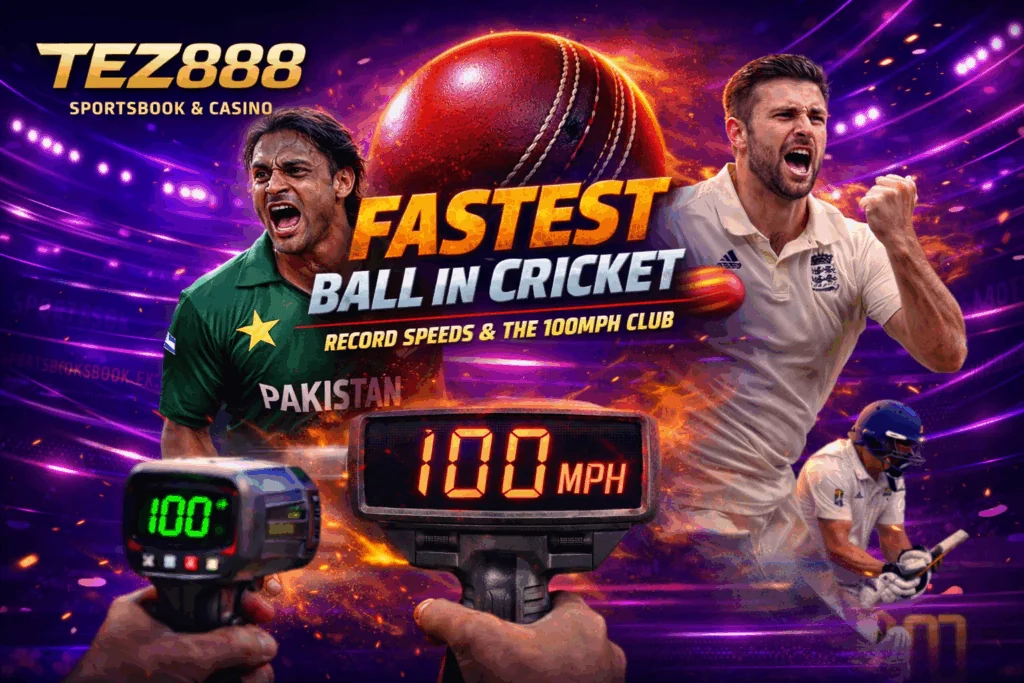
The Obsession With Speed in Cricket
There’s fast bowling… and then there’s proper fast bowling — the sort that makes a batter feel like they’ve turned up to work and someone’s fired a brick at them from 22 yards. That’s why pace is cricket’s most addictive spectacle. One moment you’re settling in with your snacks, the next you’re leaning forward like you’re fielding at silly point.
And here’s the thing: the crowd doesn’t need a wicket to get excited. Give them raw pace — a ball that hisses — and they’ll react like it’s a last-over thriller. That’s why the phrase fastest ball in cricket has become its own little obsession. It’s not just about bragging rights. It’s about the feeling that you’ve witnessed something at the edge of what a human body can produce.
For the batter, it’s brutal. The ball is gone in a blink, and you’ve got a split second to read length, line, bounce, seam, swing — and still decide whether to play, leave, duck, or pray. The technology might show numbers, but the player feels only urgency.
And hovering over it all is the holy grail: 100 miles per hour. The mythical barrier that turns a quick bowler into a headline. Talk about the fastest bowling speed in cricket and you always end up in the same place — one name, one moment, one figure that refuses to go away: Shoaib Akhtar and 161.3 km/h.
What Is the Fastest Ball in Cricket History?
Officially Recorded Fastest Delivery
The highest electronically measured delivery on record is 161.3 km/h (100.23 mph) — bowled by Shoaib Akhtar for Pakistan against England at the 2003 World Cup, at Newlands, Cape Town, on 22 February 2003.
That’s the number people come back to because it has the full package: big stage, elite batter (Nick Knight was at the sharp end), and a speed reading that hasn’t been overtaken in serious conditions. Even now, when you mention “the quickest ball in cricket,” this is the one that gets pointed at like a trophy on the mantelpiece.
Now, cricket being cricket, there’s always a debate. The ICC’s own communications line has essentially been: the speed-gun situation isn’t uniform enough worldwide for any single effort to be stamped “official” in the universal sense — as in, different venues and systems, slightly different results.
So why do most fans still treat Akhtar’s 161.3 as the benchmark? Because it’s not some mysterious one-off from a dodgy graphic — it’s a peak produced in an era when speed was a genuine arms race, and it happened in a World Cup match with global scrutiny.
And if you want proof that numbers can misbehave, look at the modern blooper reel. Mitchell Starc once had a delivery briefly shown at 176.5 km/h on a broadcast speed graphic — which would’ve broken physics, common sense, and probably the stumps too. It was later corrected (the real speed shown elsewhere was much more normal). That’s a perfect reminder: the screen can lie, even when the bowler doesn’t.
Why speed readings can get messy (even in top-level cricket):
- Different radar guns and calibration standards at different grounds
- TV graphics errors (yes, it happens)
- Era-to-era comparisons: old radar methods vs newer tracking systems like camera-based ball-tracking
- The temptation to treat a single “peak” number as the whole story of a spell
So, if you’re looking for the cleanest answer to “what is the fastest ball in cricket?” — it’s Akhtar at 161.3 km/h, with the usual cricket-shaped asterisk about measurement consistency.
Top 10 Fastest Bowling Speeds in Cricket History
Before we throw names around, one reality check: comparing pure pace across decades is tricky. Earlier eras used different radar setups, today’s broadcasts use different integrations, and not every competition measured speed the same way. That’s why some lists show tiny variations for the same legend — and why the fastest bowler speed conversation always needs a bit of context, not just a number.
Still, here’s a strong, widely accepted snapshot of the quickest recorded deliveries in international cricket:
Fastest Balls Ever Recorded in International Cricket
| Rank | Bowler | Country | Speed (km/h) | Speed (mph) | Match / Year |
| 1 | Shoaib Akhtar | Pakistan | 161.3 | 100.2 | WC 2003 vs ENG |
| 2 | Shaun Tait | Australia | 161.1 | 100.1 | Lord’s 2010 |
| 3 | Brett Lee | Australia | 161.1 | 100.1 | Napier 2005 |
| 4 | Jeff Thomson | Australia | 160.4–160.6 | 99.8 | 1975 |
| 5 | Mitchell Starc | Australia | 160.4 | 99.7 | WACA 2015 |
| 6 | Andy Roberts | West Indies | 159.5–159.9 | 99+ | Speed competition |
| 7 | Fidel Edwards | West Indies | 157.7 | 98.0 | 2003 |
| 8 | Mitchell Johnson | Australia | 156.8 | 97.4 | 2013 Ashes |
| 9 | Mohammad Sami | Pakistan | 156.4 | 97+ | 2003 |
| 10 | Shane Bond | New Zealand | 156.4 | 97+ | WC 2003 |
Sources for key anchor points in that table: Akhtar’s 161.3 record listing, Tait’s 161.1 at Lord’s, and Starc touching 160 at the WACA are well documented.
Also worth a nod:
- Dale Steyn — 155.7 km/h
- Lasith Malinga — 155.7 km/h
These two didn’t need the very top speed to be terrifying — they were nightmares because they combined pace with skill, angles, and timing.
The 100mph Club – Cricket’s Most Exclusive Group
This is the private lounge. No queue-jumping. No “I did it in the nets once.” Officially clocked at 100mph in international cricket? Only a handful have stood up to that test — and it’s a short list for a reason.
Bowlers Who Broke the 100mph Barrier
- Shoaib Akhtar
- Shaun Tait
- Brett Lee
Why is 100mph cricket’s holy grail? Because it’s not just “try harder.” It’s a violent mix of genetics, mechanics, timing, and bravery — plus a body that can survive the forces involved. Plenty can hit 90mph. Fewer can live above it. Almost nobody can cross the line into three figures and still control a cricket ball on a real pitch, against real batters, when it actually counts.
And that’s why, years later, we’re still talking about it — not because fans love a number, but because that number represents something rare: a bowler pushing the sport right up to its limit.
The Mark Wood Factor – Can the Record Be Broken?
If you’re asking, “Who looks most likely to have a proper crack at the record in the modern game?” you end up staring straight at Mark Wood. Not because he’s the biggest bloke in the world — he isn’t — but because he bowls like he’s late for a train and the train owes him money.
Wood has already flirted with the headlines: 97.7 mph to David Warner in Melbourne (2021), and 97.1 mph to Mikyle Louis against the West Indies (2024). In that same 2024 spell, he averaged 94.47 mph across an over, which is not “quick for England,” it’s quick for anyone. That’s serious heat.
And there’s a reason he’s found that extra gear. Michael Holding suggested he extend the run-up — Wood went from a stop-start approach to a longer charge, and suddenly the whole thing looks like it’s been turbocharged. The numbers behind it are nasty: it’s been calculated he puts around 7.5 times his bodyweight through his front leg at release. That’s not “athletic,” that’s borderline outrageous.
The catch, of course, is the body. Wood’s spoken about eight operations — ankles, elbow, knees, hernia — and enough injections to make a pin cushion wince. Yet he keeps coming back, and he keeps bowling fast. And he’s honest about the dream: he wants 100mph, because in cricket, that figure turns you into a permanent reference point.
So can he reach the quickest ball in cricket again — the kind of pace that makes history? If Wood strings together fitness, rhythm, and one of those days where everything feels “free and loose,” it’s not impossible. But it’s not a training drill either. It’s a perfect storm.
Why Don’t We See More 160+ km/h Bowlers Today?
People love asking why pace seems rarer now. My view? The game is busier, bodies are managed to the minute, and sometimes coaching has a habit of sanding down the edges — which is the last thing you want if you’re trying to create something extreme.
Factors Affecting Modern Fastest Bowler Speed
- Shift from side-on to front-on actions: biomechanics researcher Rene Ferdinands argues the old side-on style was more naturally speed-friendly, and that it’s been pushed aside.
- Over-coaching and standardisation: when everyone gets moulded into the “approved” action, you lose the odd, slinging, uncomfortable bowlers who used to terrify people.
- Packed schedules: franchise cricket plus international cricket means less true recovery time and more “managed” spells.
- Workload restrictions: sensible in theory, but it can stop bowlers building the sustained engine needed for top-end pace.
- Injury prevention obsession: here’s the irony — bowlers still break down. Shaun Tait’s point is simple: you can’t spreadsheet your way to 160.
- Genetics and natural pace: you can gain a bit from gym work and technical tweaks, but the very top end usually starts with natural speed.
Tait’s attitude is refreshingly blunt: let bowlers have more control, let them be aggressive, let them express it. If you want truly rapid bowling, you can’t coach the wildness out of it and then act surprised when nobody bowls like a wildfire anymore.
The Science Behind Extreme Pace
Let’s not overcomplicate it: a cricket ball is a hard little menace — 156g (5.5 oz), about 22.9 cm around, and it’s leather over a cork core wound with string. When it leaves the hand at elite speed, the batter has next to no time to make clean decisions. Over a pitch length of 22 yards (20 metres), the reaction window is brutal — read it wrong and you’re either out or wearing it.
People like to compare it to baseball, where Aroldis Chapman has hit 105.8 mph. But cricket has an extra problem: the ball can bounce, seam, swing, reverse, cut — and the surface can change everything. So even if the raw number is lower, the danger and difficulty can be higher, because the batter isn’t just tracking a straight line in the air. They’re predicting what happens after it hits the pitch. That’s why the fastest bowling speed in cricket isn’t just a stat — it’s a test of nerve.
What It Feels Like to Face the Fastest Ball in Cricket
Nick Knight has explained it better than any of us sitting comfortably ever could, because he was there when Akhtar was in full flight — not tossing in one fast ball for the cameras, but bowling an entire spell like he’d been plugged into a power socket.
“The thing to remember is it wasn’t just one ball at 100mph… Shoaib was bowling properly fast for the whole spell.” – Nick Knight
Knight’s adjustment was pure survival intelligence: stand deeper in the crease, keep body weight forward, reduce the backlift, and be mentally ready before the ball even left the hand. And the funniest detail? Akhtar was so obsessed with pace he’d bowl and immediately glance back at the speed display — like there was a scoreboard inside the over. A game within a game.
That’s what extreme pace does. It doesn’t just attack technique. It attacks time.
Speed Gun Errors & Measurement Controversies
Now, a reality check: the speed number isn’t always gospel. We’ve seen broadcast graphics throw up nonsense — like that Starc delivery briefly shown at 176.5 km/h before being corrected to a normal figure. That’s a reminder that the reading can be wrong even when the bowling is very real.
There’s also the ICC’s long-standing point: speed-gun systems haven’t always been uniform across venues, so comparing eras is messy. Add in older radar guns versus modern camera-based tracking, and suddenly you’re comparing different measuring tapes.
And then you’ve got Jeff Thomson — clocked around the high-99 mph range in the mid-1970s with older equipment. Could he have been the “true” quickest if measured with modern tech? Possibly. He had the slingy action, the fear factor, the reputation — and plenty who watched him swear the numbers didn’t fully capture the chaos.
So yes, Akhtar’s 161.3 stands tall — but cricket history is full of “what if” pace merchants who didn’t get today’s measuring tools.
Will the Record Ever Be Broken?
I’ll say this: it can be broken. Not easily. Not soon just because someone wants it. But it’s not a law of nature that 161.3 is untouchable forever.
To push beyond it, you’d need:
- Biomechanical freedom (stop forcing every bowler into the same template)
- Individualised coaching that keeps the bowler’s natural weapon intact
- Aggression and intent — because top-end pace is as mental as it is physical
- Durability (or at least smart management without draining the edge)
Could someone reach 165 km/h one day? If the game produces another freak blend of genetics, technique, and fearlessness — yes. The sport just has to decide it actually wants to create that kind of bowler again, rather than politely sanding them down into “safe and tidy.”
FAQ
What is the fastest ball in cricket history?
The most widely recognised top reading is Shoaib Akhtar’s 161.3 km/h (100.23 mph) against England at the 2003 World Cup in Cape Town.
Who bowled the quickest ball in cricket over 100mph?
Only three men are regularly cited as officially clocked over the 100mph mark: Shoaib Akhtar, Shaun Tait, and Brett Lee.
What is the fastest bowling speed in cricket today?
Modern quicks like Mark Wood and Mitchell Starc have produced extreme numbers in the high-90mph range (Wood has been timed up to 97.7 mph), but consistently crossing 100mph remains rare.
Has anyone bowled faster than 161.3 km/h?
You’ll sometimes see higher numbers flash up due to broadcast or measurement issues, but those are generally treated as errors rather than genuine records.
Why are there fewer 160+ km/h bowlers now?
A mix of action changes, coaching standardisation, packed schedules, workload limits, and injuries — plus the fact that natural high pace is rare.
Can the fastest bowler speed record be broken?
Yes — but it’ll likely take a bowler with freak natural pace, a technique that isn’t over-corrected, and a body that can survive the forces long enough to deliver it in a match that matters.